
Written by: James Whitaker
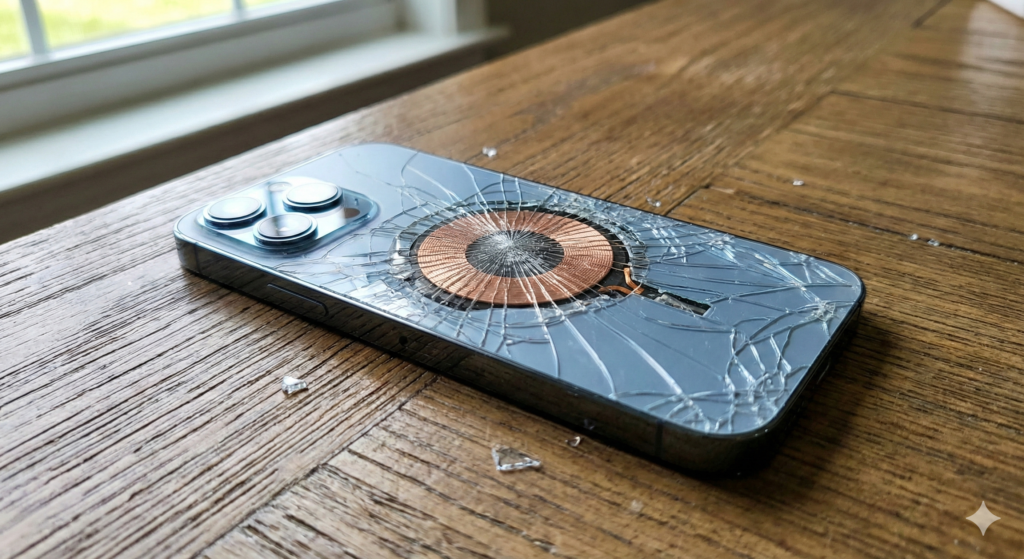
We have all been there. You are getting out of the car, or maybe you are just trying to juggle your coffee and your keys, and then—smack. That distinct, heart-sinking sound of expensive electronics hitting the pavement. You pick it up, relief washing over you because the front screen looks fine. But then you flip it over.
The spiderweb.
Cracked back glass is one of the most common issues we see at Mobile Fix Experts, yet it is also the one people ignore the most. It’s easy to justify ignoring it. You might think, “I’ll just throw a case on it and forget it happened.”
I am here to tell you, as someone who has opened up thousands of devices, that is a dangerous gamble. Unlike the plastic-backed phones of the early 2010s, modern smartphones use glass for a very specific engineering reason: Wireless Charging.
When you shatter that glass, you aren’t just breaking a cosmetic layer; you are compromising the structural integrity of the phone, breaking the watertight seal, and potentially creating a fire hazard with your wireless charger.
In this guide, we are going to walk through exactly why that back glass exists, what happens to the internal components when it breaks, and why waiting to repair a device can cost you double in the long run.
Section 1: Why Do Phones Have Glass Backs Anyway?
To understand the damage, you have to understand the design. If you look back at the iPhone 6 or the original Google Pixel, they used aluminum bodies. Metal is durable, lightweight, and feels premium. So, why did Apple, Samsung, and Google all switch to glass, which is heavier and more fragile?
It comes down to physics.
The Faraday Cage Effect
Metal blocks electromagnetic fields. If you have a metal back on a phone, it is extremely difficult to pass an electrical current through it without a physical wire. This is why the old aluminum iPhones never had wireless charging.
To introduce Qi (pronounced “chee”) wireless charging, manufacturers had to switch to a material that is “radio frequency (RF) transparent.” Plastic works, but it feels cheap and doesn’t dissipate heat well. Glass was the answer. It allows magnetic induction coils to transmit energy from the charging pad to the battery without interference.
However, this design choice introduced a massive vulnerability: the back of your phone is now just as fragile as the front.
Section 2: The Wireless Charging Nightmare
This is the most critical section for anyone ignoring a crack. When your back glass shatters, the relationship between your phone and your wireless charger changes fundamentally.
1. Misalignment and Efficiency Loss
Wireless charging relies on Inductive Coupling. There is a copper coil in your charging pad and a matching copper coil inside the back of your phone. For this to work efficiently, the distance between them (the Z-gap) needs to be minimal and consistent.
When the glass shatters, that smooth surface becomes a jagged landscape. Some pieces of glass might fall out; others might jut outward. This creates an uneven gap between the coils.
- The Result: Your charger has to work harder to bridge that gap. This leads to slower charging times and, more importantly, “charging leakage,” where energy is lost as heat rather than filling your battery.
2. The Thermal Runaway Risk
This is where safety comes in. If you have a crack running directly over the charging coil (usually the center of the phone), you have removed the insulating layer.
- Heat Concentration: A shattered back disrupts how heat dissipates. Instead of spreading evenly across the glass surface, heat can get trapped in air pockets created by the cracks.
- Coil Exposure: In severe cases, we have seen the glass shards actually cut into the protective sticker covering the charging coil. If the copper is exposed and touches moisture or debris, you are looking at a short circuit.
If you notice your phone getting unusually hot while charging wirelessly, stop immediately. It’s a sign the shattered glass is interfering with the induction process.
Section 3: The Domino Effect of “Just Ignoring It”
You might not use wireless charging. You might be a “cable-only” person. Even then, a cracked back is a ticking time bomb for your device’s internal health.
The Myth of Water Resistance
Marketing teams love to throw around terms like IP68 Water Resistant. This rating means a device can withstand submersion in 1.5 meters of water for 30 minutes.
Here is the hard truth: The second your back glass cracks, your IP68 rating is gone. Zero.
The back glass is held onto the frame with a watertight adhesive gasket. A crack breaks that seal. It doesn’t take a drop in the toilet to kill a phone with a cracked back; simple humidity can do it.
- Sweat in your pocket: If you keep your phone in your pocket while at the gym or on a hot day, body vapor can enter through the cracks.
- Rain: A single raindrop landing on the wrong crack can wick into the motherboard via capillary action.
We see this constantly at our location. A customer brings in a phone that “just stopped working.” They swear they didn’t drop it in water. But when we open it, the liquid damage indicators are red. The culprit? That “minor” crack on the back they ignored for six months allowing moisture to corrode the internal components slowly.
Structural Integrity
The back glass provides rigidity to the phone’s frame. Without it, the aluminum or steel frame is more prone to bending. If you sit on your phone with a cracked back, the frame is more likely to warp. Once the frame bends, the internal motherboard—which is screwed directly into that frame—can flex and snap microscopic connections. That is a “game over” scenario for the data on your device.
Section 4: The Financial Side – Repair vs. Resale
Many people hesitate to fix the back glass because they think it’s too expensive. They decide to wait until they upgrade to a new phone. This is a financial mistake.
Trade-In Value plummeting
Carriers and manufacturers are very strict about trade-ins.
- Good Condition: $800 trade-in credit.
- Cracked Damage: $0 – $100 trade-in credit.
By saving $100-$150 on a repair now, you are potentially losing $700 in value when you try to sell a device later.
The “Laser” Repair Technology
Years ago, fixing back glass was a nightmare. Technicians had to chip the glass off by hand with heat guns, which took hours and risked damaging the camera.
Today, professional shops like ours use Laser Separation Machines.
- We place the phone in the machine.
- The laser maps the back of the phone.
- It fires a precise beam that burns away the adhesive underneath the glass without heating up the battery or internal components.
- The glass peels off easily, and we apply a new, factory-strength adhesive and glass panel.
This process is faster, safer, and restores the phone to near-factory condition. If you are looking to buy a device, you want to make sure it hasn’t had a botched manual repair.
Section 5: Safety Hazards (The Human Cost)
We have talked about the phone’s health, but what about yours?
Modern smartphone glass is chemically treated (like Corning Gorilla Glass) to be scratch-resistant. However, when it shatters, it fractures into microscopic shards.
- The Pocket Problem: As the phone flexes in your pocket, tiny glass splinters shed from the cracks. These end up in your pocket lining and can work their way into your skin or under your fingernails.
- The “Case” Trap: Putting a case over shattered glass feels like a solution, but the friction between the case and the glass grinds the shards into a fine powder. This powder can scratch the aluminum frame of the phone, ruining its cosmetics further, and eventually work its way into the charging port or speaker grills.
Conclusion
A shattered back glass is an annoyance, certainly. But viewing it as merely a cosmetic blemish is a misunderstanding of how modern technology works. The glass is a functional component of your device’s power management and protection system.
Leaving it broken risks overheating your battery during wireless charging, losing your water resistance, and slashing the resale value of the phone you paid hundreds (or thousands) of dollars for.
Don’t wait for the damage to spread to the motherboard. If you are dealing with a cracked back, let’s get it sorted.
Ready to fix it? You can check out our services at Mobile Fix Experts. If you are unsure if your device is worth saving or if you should upgrade, visit our Contact Us page and ask our technicians directly. We are here to help you make the smart choice for your tech.
FAQs
Q1: Can I still use a wireless charger if my back glass has a hairline crack? A1: Technically, yes, but it is risky. Even a hairline crack can expand due to the heat generated by wireless charging. If the crack crosses the area where the charging coil is, you risk thermal issues. It is best to stick to a wired cable until you get it fixed.
Q2: Will replacing the back glass restore my phone’s water resistance? A2: If done by a professional using the correct adhesive and clamping tools, yes, it can restore the water-resistant seal. However, no repair shop can guarantee “factory” IP68 ratings because we don’t have the vacuum-sealing chambers used in the original factory. But it will be significantly more resistant than leaving it broken.
Q3: Can I fix the back glass myself? A3: We strongly advise against DIY back glass repair. The adhesive used by Apple and Samsung is basically industrial cement. Without a laser machine to burn the glue, you have to use high heat and sharp pry tools. One slip can puncture the battery (causing a fire) or sever the wireless charging cable.
Q4: How long does a back glass repair take? A4: With the laser technology we use at Mobile Fix Experts, the repair is much faster than the old manual methods. It can typically be done within a few hours. Check our About Us page to learn more about our tech.
Disclaimer
The information provided in this post is for educational purposes only. While we strive to provide accurate technical advice, attempting DIY repairs on modern electronics carries risks. Mobile Fix Experts is not responsible for damage caused by self-repair attempts. For safety, always consult a professional for battery and glass-related damages.